

IP Routing & Territory-Based Compliance
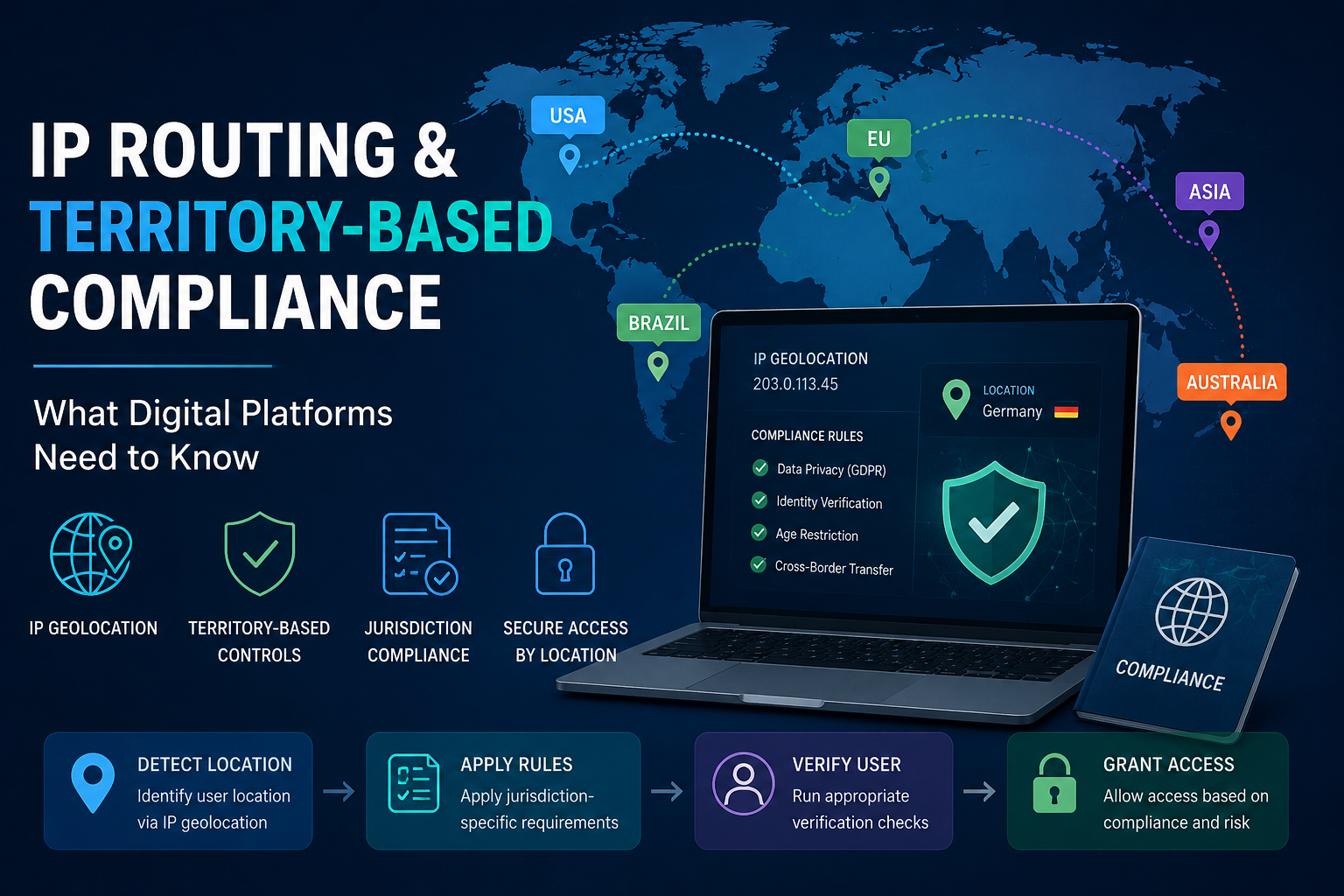
A digital platform can reach customers in dozens of countries within minutes. The challenge begins when those customers are subject to different laws, regulatory requirements, and access restrictions.
A user accessing a platform from Germany may be subject to different privacy requirements than someone connecting from Brazil. A service available in one market may need additional verification in another, while certain products or features may not be permitted in particular territories at all.
For businesses operating internationally, compliance can no longer be treated as a single global rule. Platforms need to understand where users are accessing their services from and use that information to apply the appropriate controls.
This is where territory-based compliance, IP routing, and location intelligence become important. By combining IP geolocation with account information, verification data, and other risk signals, digital platforms can build workflows that respond to jurisdiction-specific requirements without creating unnecessary friction for every user.
Regulations often depend on geography.
A platform may have one set of obligations for users in the European Economic Area, another for users in the United States, and additional requirements for customers in countries with specific financial, privacy, age-verification, or content regulations.
The European Union's GDPR is a good example. Its protections can continue to apply when personal data is transferred outside the EU, meaning that simply moving data to a server in another country does not remove the underlying obligations.
Other regulations can also have effects beyond the physical location of a company. For example, the EU AI Act can apply to certain providers established outside the EU when their AI systems or outputs are connected to the EU market.
This creates an important operational question for digital platforms:
How do you determine which rules should apply to a particular user?
The answer often starts with location signals.
Territory-based compliance is the practice of adapting a platform's rules, access controls, verification processes, and data-handling workflows according to the jurisdiction associated with a user or transaction.
Instead of applying one identical compliance policy globally, a platform can create territory-specific rules.
For example, a platform might:
This approach allows businesses to build compliance into the platform itself rather than relying entirely on manual reviews.
One of the most common location signals is the user's IP address.
IP geolocation compliance uses an IP address to estimate the country, region, or other geographic information associated with an internet connection. A platform can then compare that location against its compliance rules.
For example, suppose a user attempts to access a service that is available only in selected countries. The platform can evaluate the user's IP location before allowing registration or access.
IP geolocation can also be used as an early risk signal during:
However, IP geolocation should not be treated as an infallible source of identity or location.
MaxMind, for example, estimates country-level accuracy for its GeoIP products at 99.8%, but notes that accuracy varies by country and connection type. It also states that IP geolocation cannot precisely identify a specific household, person, or street address. VPNs and anonymizing proxies can create additional challenges.
That distinction is important: an IP address can be a useful location signal, but it should rarely be the only signal used for a high-impact compliance decision.
A stronger compliance system combines multiple pieces of information.
Consider a user whose IP address indicates France, while their verified identity document shows another country and their payment information is associated with yet another location.
That does not automatically mean the user is fraudulent. They could be traveling, using a corporate network, or connecting through a VPN.
Instead of immediately blocking the user, the platform can treat the mismatch as a signal that additional verification may be appropriate.
Other useful signals can include:
This creates a more complete picture of the user's location and risk.
Location intelligence becomes particularly useful when connected directly to identity verification.
A platform doesn't necessarily need every customer to complete the same verification process. Instead, it can create different verification workflows based on territory and risk.
For example, users in one jurisdiction might only need email and phone verification during registration. Users in another territory could be required to complete identity document and biometric verification before accessing certain features.
The platform could use a simple decision flow:
Location detected → Applicable rules identified → Risk assessed → Verification level selected → Access granted or restricted
This makes compliance more dynamic.
It also prevents a common problem with global platforms: applying the strictest possible process to everyone simply because regulations differ between countries.
Location-based compliance becomes even more important when personal data crosses national borders.
A company may have its headquarters in one country, cloud infrastructure in another, identity verification providers in a third, and customers across dozens of markets.
This creates a complex data flow.
Under EU rules, international transfers of personal data may require mechanisms such as adequacy decisions, standard contractual clauses, binding corporate rules, or other safeguards, depending on the circumstances.
For this reason, cross-border compliance should not be considered only an access-control problem. Businesses also need to understand where user information is collected, processed, stored, and transferred.
A location-aware architecture can help organizations determine which processing workflow should be used for different users.
IP-based controls are useful, but they have limitations.
A user can connect through a VPN, corporate proxy, mobile network, or other infrastructure that makes their apparent location different from their actual physical location. Even without a VPN, mobile and broadband IP addresses may not provide precise geographic information.
This means a simple rule such as "IP address = country = compliance decision" can produce false positives and false negatives.
A better model is to treat IP routing as one component of a broader decision engine.
For low-risk activities, IP-based country detection may be sufficient to select the appropriate experience. For high-risk actions, the platform can request additional evidence.
For example, an unusual location combined with a new device and a high-value transaction could trigger additional identity verification.
The most practical approach is to create a territory matrix.
Each market can be assigned rules covering areas such as:
| Area | Example Control |
|---|---|
| Access | Allow, restrict, or block |
| Identity | Basic or enhanced verification |
| Age | Standard or additional age verification |
| Payments | Territory-specific payment controls |
| Privacy | Regional consent and notice requirements |
| Data | Storage and transfer restrictions |
| Transactions | Additional monitoring or verification |
The matrix should then connect to the platform's decision engine.
When a user arrives, the system identifies relevant location signals, determines the applicable territory, evaluates the user's risk, and selects the correct workflow.
This approach also makes regulatory updates easier to manage. When a requirement changes in one jurisdiction, businesses can update that territory's policy rather than redesigning the entire platform.
Compliance does not have to mean adding friction to every interaction.
A good territory-based system works quietly in the background whenever possible.
For example, the platform can determine the user's likely country during the initial request. If the user is in a low-risk territory and the requested action does not require enhanced verification, they can continue normally.
If the user attempts an action that requires stronger controls, the platform can request the necessary verification at that specific point.
This creates a risk-based compliance experience rather than a one-size-fits-all process.
The result can be better for both sides: businesses gain stronger regulatory controls, while legitimate customers avoid unnecessary verification steps.
Territory-based compliance should not stop after onboarding.
A user who was verified in one country may later access the account from another territory. Sometimes this is completely normal. People travel, change devices, or use different networks.
But sudden and repeated location changes can also indicate account sharing, account takeover, VPN usage, or other suspicious activity.
Platforms can therefore monitor changes in location over time.
A significant change does not necessarily require an account suspension. Instead, it can trigger additional authentication or identity verification when appropriate.
This makes location intelligence part of continuous risk monitoring rather than a one-time registration check.
Global digital platforms operate in an environment where territory-based compliance is becoming increasingly important. Different countries can impose different requirements around privacy, identity, payments, access, age restrictions, and data transfers.
IP geolocation compliance provides a practical first layer for identifying the likely territory associated with a connection. However, IP information has limitations and should be combined with identity, payment, device, and behavioral signals when decisions carry greater compliance or financial risk.
For organizations operating internationally, cross-border compliance also requires visibility into where personal data is collected, processed, stored, and transferred. The EU's international data-transfer framework demonstrates how geographic considerations can directly affect the way businesses handle personal information.
Ultimately, the goal is not simply to identify a user's country. It is to use location as one part of an intelligent compliance framework that can adapt verification, access, and data-handling workflows to the requirements of each market.
When implemented correctly, territory-aware controls allow digital platforms to scale internationally while maintaining stronger control over regulatory risk, user verification, and access management.